


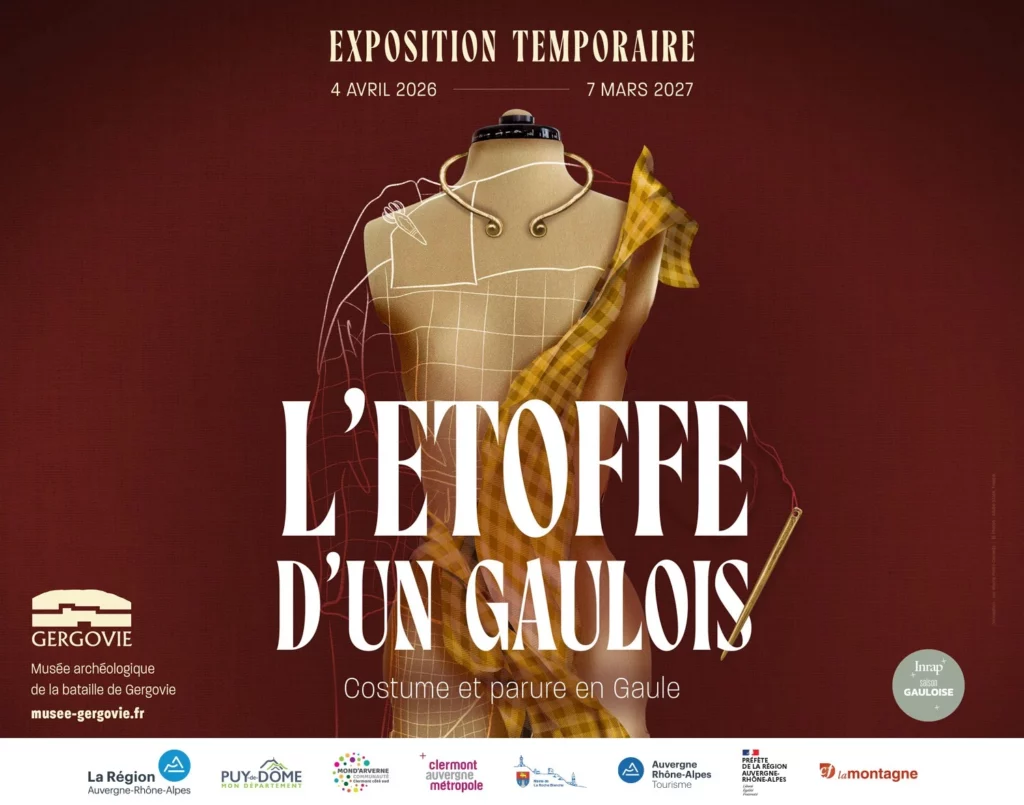
Discover the Gergovia Museum’s new exhibition: ‘Cut from Gallic cloth. Costume and jewellery in Gaul’
Figuring out Gallic people’s clothing has inspired countless fantasies since the 19th century – whether artistic or historical. What do archaeological discoveries reveal today about their dress habits ? The “Cut from Gallic cloth. Costume and jewellery in Gaul” exhibition bridges scientific research and experimental archaeology to offer an immersive experience that is both engaging and rigorously documented, plunging visitors into the cutthroat world of Gallic fashion.
Painters and sculptors in the 19th century were the first to attempt creating instantly recognisable depictions of the Gauls. However, they only had access to very limited sources to reconstruct the various elements of Gallic clothing, as textile fibers are rarely preserved over time. It was therefore in the imagination of artists specialised in historical scenes that an image of Gallic costume gradually took shape—an image that, while familiar to us today, is most often entirely fanciful.
Today, advances in archaeological analysis and a better understanding of the preservation of organic remains, combined with experimental archaeology, allow for a better understanding of Gallic clothing. The exhibition “Cut from Gallic cloth” invites visitors to explore each step of the creation of an authentic Gallic costume, from the production of fibers to the methods of tailoring and assembling garments, not to mention the processes involved in crafting pieces of jewellery.
We are very pleased to invite you to enter our « In Braccae and in Brogues » fashion boutique to embark on a journey through the major trends of Celtic fashion during the last five centuries before the Common Era.
Discover this blend of history and style with the museum’s new temporary exhibition, from 4 April 2026 to 7 March 2027.
The exhibition designed with the scientific contribution of the Regional Archaeology Service (DRAC AURA), Moires Association, the Bargoin Museum of Clermont-Ferrand, and the archaeological service of the Puy-de-Dôme Department. We would like to thank the Musée de Picardie in Amiens, the Musée Anne de Beaujeu in Moulins, the Musée d’Archéologie et du Patrimoine Marius Vazeilles in Meymac, and the Musée des Beaux-Arts in Orléans for their object loans.